3Degrees of freedom
How many different ways can this thing move?
This assumes nothing. About 6 minutes of reading.
Hold one arm out in front of you and lock everything except your elbow. Keep the shoulder still, keep the wrist still, and bend only the elbow. Watch your hand. It can travel along one curve and nowhere else: an arc, like a windscreen wiper.
Now let your shoulder move as well. Your hand can go anywhere in a wide region: high, low, near, far, and every place in between. Nothing about your arm changed except how many of its joints were allowed to move. That difference, between a curve and a region, is the whole idea of this module.
Each joint you free up is a degree of freedom: one independent way the thing can move. "Independent" is the important word. Bending the elbow does not force the shoulder to move, and lifting the shoulder does not force the elbow to bend. You can change one while leaving the other exactly where it was, so each counts as one.
There is a second way to say the same thing, and it is the one engineers use. A degree of freedom is one number you have to give to say where the thing is. With only the elbow free, one number — how far it is bent — says everything about your arm's pose. Free the shoulder too and you need two numbers; free the wrist and you need three. Counting degrees of freedom is counting how many numbers it takes to pin the whole thing down.
Try it on a robot
The arm in the box below is a simple one, built for this course. It has three joints — a shoulder, an elbow and a wrist — and every part of it moves in one flat sheet, the way your arm did when you held it out in front of you. It starts with only the shoulder switched on; the other two are held still, as if they were welded. A blue line follows the hand and shows everywhere it has been. "Clear trace" wipes the line, and "Reset" puts the whole arm back the way it started. There is a star. See what it takes to reach it.
This is easier on a larger screen, but it works here too.
What you saw
With one joint the hand drew a curve, and the star was not on it. The hand could be at any point along that curve, but nowhere off it. One degree of freedom buys you a line.
With two joints the arcs stacked up into a band. Each sweep of the shoulder drew one arc, and each nudge of the elbow shifted the next one inward or outward, so between them they can put the hand anywhere inside a broad ring. The star was inside it. Two degrees of freedom buys you an area.
With three joints the hand gained a little ground — a free wrist lets it curl in closer to the base — but the interesting part is choice. Once the hand was on the star there was a second pose that also put it there, and a third, and in fact a whole family: elbow high with the wrist bent one way, elbow low with it bent the other, the shoulder adjusting to suit. Getting from one to the next takes all three sliders, because moving any one joint on its own pulls the hand off the star. For the job of putting the hand at a point, the third joint is extra: it gives you more than one way to do the same task.
The count, in every case, was the number of joints you were allowed to move. On an arm, every joint that can move on its own is one degree of freedom.
Why the number keeps coming up
Ask what the arm in the box would need to put its hand anywhere in the sheet and point it any way you like. Where the hand is takes two numbers: how far forward, how high. Which way it points takes one more: its tilt. Two plus one is three, and the arm has three joints. In its flat world the third joint was only spare while you ignored the tilt; ask for a place and a tilt together and all three are needed.
Now leave the sheet for the real world. Where something is takes three numbers: how far forward, how far to the side, how high. Which way it points takes three more: tilted up or down, turned left or right, rolled around its own length. Three plus three is six, which is why so many robot arms have exactly six degrees of freedom. Engineers call the line a joint turns around its axis, so the "six-axis" written on the side of many of them means six turning joints. Fewer than six and there are positions or angles the hand can never take up. More, and the arm has spare freedom.
Your own arm has seven: three at the shoulder, one at the elbow, three at the wrist. That one spare freedom is why you can hold a cup perfectly still and still move your elbow around while you do it. It is the family of poses from the star again.
Other robots have other counts. A rover driving on a flat floor has three: two numbers say where it is and one says which way it faces. None of those is a joint. The rover moves as a whole, so counting joints tells you nothing, but counting numbers still works — which is why that is the way engineers keep. A drone in the air has six, the same three-plus-three as the arm's hand. A door has one.
Two honest footnotes
First, a degree of freedom is a way the thing can move, whether or not anything is driving it. A door hinge is one with no motor attached. So the arm in the box has three degrees of freedom whatever the sliders say: with only the shoulder switched on you were using one, and the other two were there, held in place by their motors. Switching a joint on did not add a degree of freedom, it let you use one.
Second, the arm in the box lives in a flat sheet, and real arms do not. A real shoulder also turns sideways, out of the sheet: one more joint, one more number, counted the same way. The simulation left it out so that the trace stays easy to read.
Next time you see a robot, try counting: joints that move on their own for an arm, numbers to say where it is and which way it faces for anything that moves as a whole. That number tells you, before it has moved at all, roughly what it will and will not be able to do.
Watch
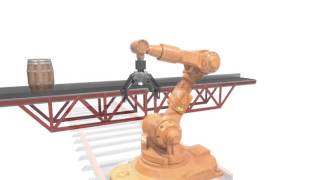
Robot Axes Explained | Degrees of Freedom, Pitch, Roll and Yaw — Engineering Technology Simulation Learning Videos (2:47 of it, starting at 0:00)
- Why this video
- It moves a full-size six-axis factory robot one axis at a time — waist, shoulder, elbow, then the three wrist turns — so you can count the sliders on a real robot's shape instead of a three-joint sketch, and it splits them into the three that place the tool and the three that point it, which is the whole reason six keeps coming up.
- What to watch for
- Around 0:15 to 0:35, each joint moves on its own while the others hold still — the same thing you did with the sliders. Then from about 1:05, watch the wrist: three separate turns happen at one joint, which is why a wrist can be worth three degrees of freedom.
Words introduced
- degree of freedom
- One independent way a thing can move — one number you have to give to say where it is. A robot arm usually has one per joint.
Where next
Suggested next: 4. Joints: the ones that turn and the ones that slide