9Motors: force, speed, and gears
A motor is strongest standing still and weakest at full speed. Put a weight in a real arm's hand, shift its gears, and watch it choose between fast and strong.
This assumes: The parts of a robot. About 9 minutes of reading.
Ride a bicycle at a hill in a high gear and your legs slow, strain, and stop. Shift down and you climb: your feet spin quickly and the bicycle crawls. Your legs did not get stronger. The gears changed what your effort was turned into, force at the back wheel or speed at the back wheel, and you cannot have both at once.
Every electric motor makes the same bargain, and every robot is built around it. The arm in the box is the SO-101 from the module on a robot's parts, each joint turned by a servo: a black box holding a small motor, a stack of gears and a sensor. That module said the gears turn a fast, weak spin into a slow, strong one. This one looks at what "fast" and "strong" cost.
Force that turns
A motor does not push in a straight line; it twists. Torque is turning force: how hard a motor twists its shaft, or how hard gravity twists an arm about its joint. It is measured in newton meters, written N·m. An apple weighs about a hundred grams, which pulls down with about one newton. Hold a meter-long stick out level with the apple on the far end, and it twists your hand with one newton meter. Hold the stick by its middle and the same apple twists with half as much, because the lever is half as long. Tilt the stick up toward vertical and the twist fades, because what counts is how far out sideways the apple sits, and as the stick rises it moves in over your hand. Level is where a weight twists hardest.
The motor at the arm's shoulder lift, the joint that tips the whole arm up and down, can twist with 2.94 N·m. A kilogram pulls down with about ten newtons, so that is a bag of sugar held 30 centimeters out from the shoulder. The motor lifts the arm only while its twist is bigger than gravity's.
The bargain inside every motor
A motor's torque is not a fixed number: the faster the motor is already turning, the less torque it has left. To see why, you need two words about electricity. Current is electricity flowing through a wire, the way water flows through a pipe; voltage is the pressure that drives it, and the more pressure, the more flow. Inside a motor is a coil of wire between magnets. Current through the coil makes it twist against the magnets, in proportion: twice the current, twice the twist. The supply, a battery or a power lead, provides a fixed pressure to push that current through.
The catch is that the same coil and magnets work the other way round too. Move a wire past a magnet and a pressure appears in the wire; that is all a bicycle dynamo is, and it is why the pedals get heavier when the lamp is on. So a motor is also a generator: spin it and it makes a pressure of its own, twice the speed, twice the pressure. A running motor therefore pushes back against its supply, and only the difference between the two pressures drives current through the coil. Standing still there is no push-back and the motor gives its most. As it speeds up the push-back grows, the difference shrinks, less current flows, and the twist falls. At some speed the push-back equals the supply, no current flows, and the motor can turn no faster by itself.
Two numbers pin the ends of this. The stall torque is the most a motor can give, and it gives it only when standing still; a load that asks for more stalls it, and a heavier one pushes it backward while it gives everything it has. The no-load speed is the fastest a motor can turn under its own power, with nothing to push against; at that speed it has no torque left. Because the push-back grows in step with the speed, the current shrinks in step, and the twist with it, the torque falls in a straight line from one end to the other: at half its no-load speed a motor has half its stall torque to spend.
The servo in the box is given the real one's two numbers: 2.94 N·m standing still, and about 270 degrees per second with nothing to push against.
The box
The arm holds its elbow and wrist straight, so from the shoulder out it is one long lever with the hand on the end. The shoulder lift's servo has been told to hold 10 degrees, which points the arm forward and slightly down, near level, where gravity pulls on it about as hard as it ever can. Lift tells the servo to go to minus 40 degrees instead, well up, and Lower brings it back. Told to go somewhere far off, a servo asks its motor for everything it has until it gets close, so every lift here starts at full torque.
Above the sliders, the motor line states the motor's two numbers at the current gear. The chart shows the target and the angle, the speed, and, in the bottom panel, the torque the motor is giving against a dashed line: the most it could give at the speed it is turning right now. The line under the chart says where the arm is, the fastest it went on its last move, and how much of its torque the motor is using. While the arm holds still, that last number is gravity's twist on the shoulder, since the motor exactly balances it: about 0.7 N·m for the arm's own weight. Anything in the hand adds about 3.3 N·m per kilogram, because in this pose the weight sits about 33 centimeters out from the shoulder.
This is easier on a larger screen, but it works here too.
Start with nothing in the hand and press Lift. The arm is up in well under a second, its speed peaking at about 190 degrees per second.
The dashed line is the bargain drawn live. When you pressed Lift the arm was still, so the motor had all 2.94 N·m, and the torque jumped up to meet the line. As the arm picked up speed the line sank, because a faster motor has less to give, and the torque sank with it.
What sped the arm up was only what was left over. About 0.7 N·m went on holding the arm's weight; the rest, the surplus, sped the arm up. As the line sank the surplus shrank, so the arm gained speed more and more slowly, and would have stopped gaining where the line met gravity's 0.7. That is why it never got near 270: 270 is for a motor with nothing to push against, and this one always had an arm to hold up.
Adding a load
With half a kilogram in the hand, gravity's twist is about 2.3 N·m. The motor has 2.94 standing still, so it can lift, but the surplus is smaller and the falling line meets what gravity needs at a lower speed. Slower, then, and it was.
With a full kilogram, gravity asks for about 4 N·m, the arm's 0.7 and the weight's 3.3. That is more than the motor has even standing still, so it cannot lift, and cannot even hold: the arm sinks until the table takes the weight, with the motor giving everything it has the whole way down. And lowering a loaded arm is a drop, not a descent, because gravity helps on the way down and stopping a falling weight takes torque too.
Gears
The way out is the one your bicycle offered. Picture a small wheel with ten teeth driving a big wheel with forty. The teeth are all the same size, so the big wheel is four times as far across. The small wheel must turn four times to turn the big one once, so the big wheel turns at a quarter of the speed. But the teeth meet at the rims, tooth pushing on tooth with one and the same force, and on the big wheel that force acts four times as far from the center: a lever four times as long, like the apple on the longer stick. Four times the torque, at a quarter of the speed. That number, the four, is the gear ratio: how many turns the motor makes for one turn of what it drives.
The Gear ratio knob multiplies the servo's own gearing: 1.00× is the servo as built, and 2.00× puts a further two-to-one between its motor and the joint, so 2.94 N·m become 5.88 and 270 degrees per second become 135. The whole falling line moves: taller and shorter.
A ceiling, not a target
At 4.00× with Payload back at 0, press Lower: the arm comes down at a steady 70 degrees per second the whole way, the torque and the dashed line both at almost nothing.
Through a ratio of four, the motor can turn no faster than about 68 degrees per second under its own power. Lowering the arm, gravity is on the motor's side and would gladly go faster. Why does it not? There is no freewheel in a servo: the motor is geared to the joint both ways, so whatever the joint does, the motor is spun with it. And a motor spun faster than its no-load speed is a generator that has won. Its own pressure now exceeds the supply's, so the current runs the other way through the coil, and a current the other way is a twist the other way: the motor brakes, harder the further past its no-load speed it is dragged. So the arm speeds up until it is just past 68, where the braking balances gravity's pull, and stays there.
The trade cuts both ways
The motor line was not lying: at 0.50× it comes down to meet gravity's 0.7 at about 280 degrees per second, well above the as-built 190, and on a lift twice as long the arm does get there. But getting up to speed takes surplus torque, and at 0.50× the motor has only 1.47 N·m, of which 0.7 goes on holding the arm's weight. What is left accelerates the arm so gently that this lift is over before the arm is anywhere near the speed the line allows; even on the longer lift it arrives later, for the time it lost getting going.
So the right ratio depends on the load and the moves. That is why the servo has several hundred turns of gearing inside it: a motor the size of your thumb is all speed and no torque, and the gears trade most of that speed for enough torque to lift an arm.
What the simulation leaves out
The motor in the box has the real servo's two numbers and nothing else. A real servo held at stall against a load it cannot lift draws its maximum current and heats up; after a minute or two it would cut out or burn out, and the arm you left resting on the table would go limp. The simulated one holds for ever. None of that changes the bargain, and every robot you will meet is designed around where, between strong-and-still and fast-and-feeble, its job lives.
Watch
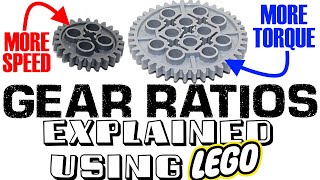
NEVER be confused by GEAR RATIOS again - EXPLAINED in the MOST VISUAL WAY using LEGO — driving 4 answers (7:49 of it, starting at 0:00)
- Why this video
- It is the exhibit done with real parts. A small Lego motor is bolted to a heavy arm with a wheel on the end and cannot move it; a bigger motor can. Then an 8-tooth gear goes on the small motor and a 40-tooth gear on the arm, and the small motor lifts the arm on its own. The video counts the teeth, gets the ratio of 5, multiplies the torque by it and divides the speed by it, and then swaps the two gears round so the arm spins fast and feeble. What it does not show is the other half of this module: a motor's torque falling as it speeds up. Its motors are given one torque number and one speed each, as if fixed.
- What to watch for
- At 0:53 the small motor stalls against the heavy arm and at 1:56 the same motor lifts it through two gears. At 2:36 the teeth are counted, 8 driving 40, and at 4:42 the price: 275 turns a minute become 55. At 6:14 the gears are swapped and the arm turns faster than ever, with a fifth of the torque.
Words introduced
- torque
- Turning force. How hard a motor twists its shaft, or how hard gravity twists an arm about its joint. Measured in newton meters, written N·m, the twist of a one-newton pull at the end of a one-meter lever.
- stall torque
- The most torque a motor can give, which it gives only when standing still. A load that asks for more stalls it, and a heavier one pushes it backward.
- no-load speed
- The fastest a motor can turn under its own power, which it reaches only with nothing to push against. At that speed it has no torque left to give.
- gear ratio
- How many turns the motor makes for one turn of what it drives. A ratio of 4 gives four times the torque at a quarter of the speed. Nothing is gained for free.
Where next
Suggested next: 10. Gravity and momentum: why arms sag and overshoot